
For sale Castle Châteaumeillant 18370

- castle
-
- CHATEAUMEILLANT (18370)
- 935,000 €
- Agency fees chargeable to the seller
- Ref. : 4845
- Surface : 500 m²
- Surface : 3.45 ha
- rooms : 14
- bedrooms : 5
- bathrooms : 2
- shower rooms : 3
Estimated amount of annual energy expenditure for standard use: between 17620€ and 23910€ (ref : 2021, 2022, 2023)
Ref.4845 : In the Heart of the Berry Region, a 15th–17th C. Château with Park, Moat and Outbuildings
Just three hours from Paris by motorway, southern Boischaut is a region that combines the gently rolling plains of the Paris Basin with the foothills of the Massif Central, which feature a more rugged terrain.
This natural region, covering the southern parts of the Indre and Cher departments—that is, the former province of Berry—is primarily devoted to cattle farming. The landscapes here are therefore green and often dotted with hedgerows, possessing a discreet yet enduring charm. It is “Le Berry, which takes hold of you and never lets you go” as described by George Sand, a native of the region.
The area is ideally situated in the centre of France, close to two major motorways: the A20 ‘L’Occitane’, linking Brussels and Paris to Toulouse on the one hand, and the A71 ‘L’Arverne’, providing access to Clermont-Ferrand and, beyond that, Montpellier from the capital.
Chateaumeillant, La Châtre and Saint-Amand-Montrond, small towns full of character with a rich history, are located near the château. The first is known for its high-quality vineyards, the second lies at the heart of the ‘Pays de George Sand’, with its many events, and the third, dubbed the ‘City of Gold’ as it is France’s third-largest centre for gold jewellery production, is often associated with Noirlac Abbey, a marvel of Cistercian architecture situated nearby. Finally, for younger visitors, Sam Parc, also located in Saint-Amand Montrond, is one of the best amusement parks in the Centre region.
Just a little further on, Bourges is a major city of art and history, making it a natural choice to become the European Capital of Culture in 2028. You’ll love strolling through its historic and shopping centre, between the Palais Jacques-Cœur, a masterpiece of Flamboyant Gothic architecture, and Saint-Etienne Cathedral, a UNESCO World Heritage Site.
As the capital of the Berry region, Bourges is not just an open-air museum. The city lies at the heart of a vibrant economic region where the aerospace and defence industries are particularly well represented.
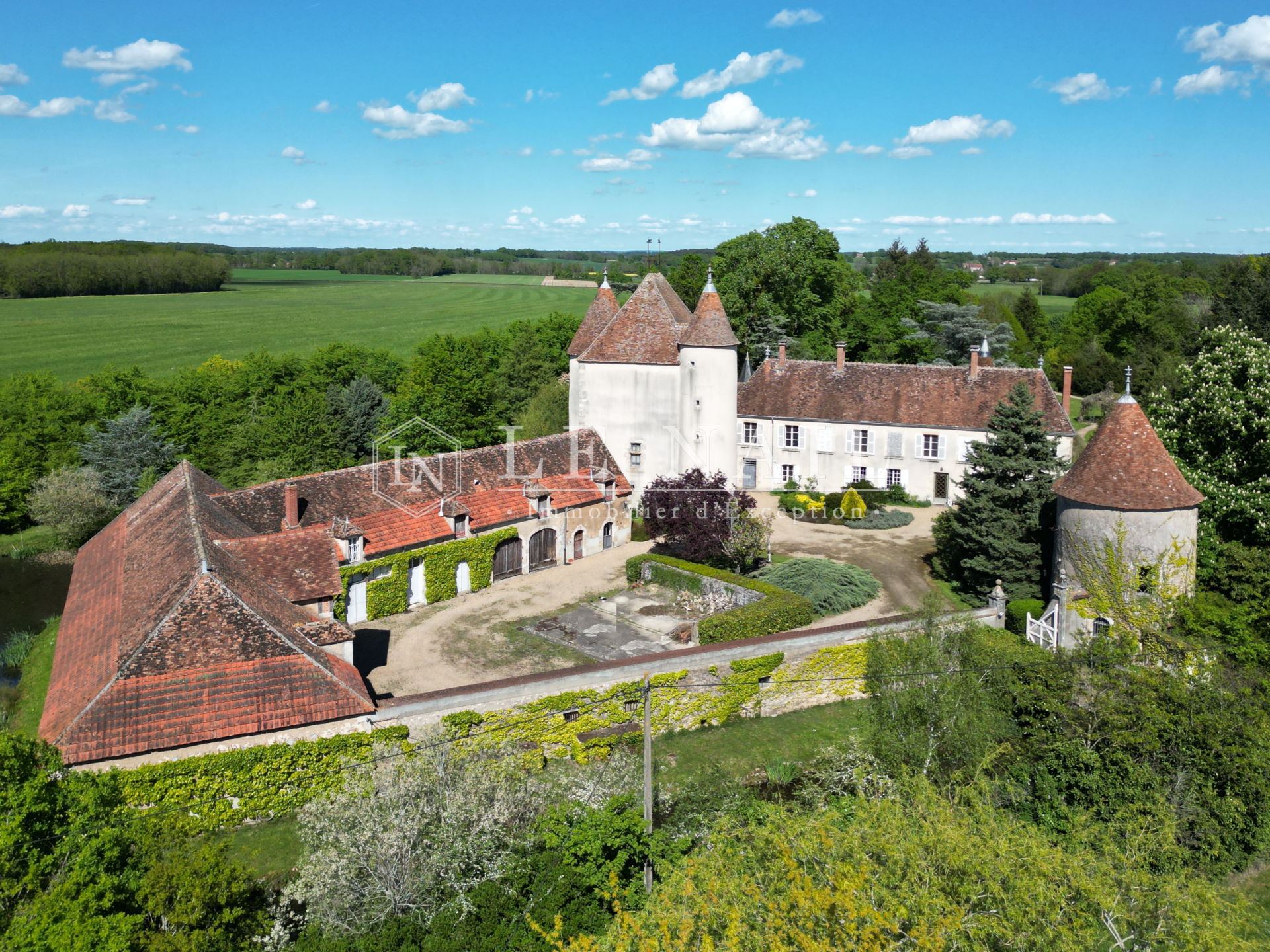
The château is approached by way of a fixed bridge spanning the former moat, its entrance symbolically guarded by a tower. Beyond lies a splendid esplanade upon which the residence reveals itself as a classic 17th-century manor house adjoined by a remarkable medieval keep flanked by two towers, one of which contains a staircase turret.
The manor itself rises over three storeys, including an attic level beneath a hipped roof clad in flat tiles and crowned with two lead finials along the ridge. At the north-eastern corner of the roof stands a purely decorative brick échauguette. The principal façades, oriented east to west, display elegant rows of windows adorned only with subtly projecting sills. On the eastern elevation, a remarkable wrought-iron and glass pergola inspired by the Art Nouveau style occupies the centre of the building. On this same façade, to the south, stands a neo-Gothic stair tower.
To the north of the manor, a narrower and lower rectangular structure provides the connection between the northern tower and the keep.
The northern tower, imposing in mass, rises over three levels beneath a conical roof. The keep itself is square in plan and surmounted by a pavilion roof clad in flat tiles, its ridges embellished with ornamental lead finials. At its south-western corner stands a staircase turret capped with a conical roof. Defensive openings remain visible at several points throughout the structure.
Upon entering the manor house, one finds on the ground floor a through entrance hall leading, to the right, into a vast drawing room with fireplace, illuminated by windows opening onto both sides of the building. At the far end of the entrance hall lies access to the neo-Gothic stair tower, while to the left are the dining room, opening onto the pergola, and a small ancillary room serving as a secondary kitchen. Proceeding along the corridor and still to the right are a return staircase ascending to the upper floor, a lavatory, a small artist’s studio, and, beyond a few steps, a spacious kitchen with adjoining laundry room and pantry. This kitchen enjoys a terrace to the east and an exit onto the arrival esplanade to the west.
The return staircase leads to the first floor, where a broad corridor gives access to four bedrooms, three with shower rooms and one with a bathroom. At approximately one-third of the corridor’s length stands a wooden staircase ascending to the attic floor, formerly used as servants’ quarters. At the second third, a landing provides access to an independent lavatory and to the neo-Gothic stair tower.
Returning northwards, the corridor passes an independent lavatory featuring the remains of an archway, before narrowing as it enters the connecting building. It then opens onto a large bedroom with bathroom and continues towards the keep’s grand hall, an impressive room with generous ceiling height, illuminated to the north and south by stained-glass windows with window seats. A monumental fireplace bearing the arms of the Boissieu family, still in working order, lends great distinction to the space. A narrow passageway gives access to a charming study located within the northern tower.
A short corridor then leads to the stair turret and up to the second floor of the keep, where one first encounters a long storage room, formerly the château’s fruit store, before entering a vast hall with fireplace and windows fitted with stone seats, currently used as a billiard room.
The staircase continues upwards to magnificent attic spaces beneath a timber framework shaped like an inverted ship’s hull.
Beneath the keep lie a former wine storehouse and a wine cellar.
The outbuildings are, for the most part, grouped together in a large U-shaped complex, comprising a tack room, a shed, a stable used as a garage, a four-room flat (including three bedrooms) used as a guest house, a very large cowshed, a donkey stable and a number of small outbuildings. The property is in fairly good visible condition.
In the grounds, there is a beautiful greenhouse-orangery that could be used as a reception room, in good visible condition.
The grounds, covering a total area of 8.5 acres, are shaped like an isosceles triangle. The château and outbuildings are situated at the base of the triangle, whilst the park, criss-crossed by several beautiful avenues, occupies the rest.
An interesting feature of the site is that the moats and water ditches form an enclosure separating an ‘inner park’ – an English-style garden, beautifully landscaped and well-maintained – from an ‘outer park’, which is more natural in character and features a pretty pond. A small bridge and a footbridge allow visitors to move from one area to the other.
This layout lends the whole site a distinct romantic charm.
Cabinet LE NAIL – Berry - Limousin - Mr Christian MAUVE : +33(0)2.43.98.20.20
Christian MAUVE, Individual company, registered in the Special Register of Commercial Agents, under the number 437 693 534.
We invite you to visit our website Cabinet Le Nail to browse our latest listings or learn more about this property.
Information on the risks to which this property is exposed is available at: www.georisques.gouv.fr
Just three hours from Paris by motorway, southern Boischaut is a region that combines the gently rolling plains of the Paris Basin with the foothills of the Massif Central, which feature a more rugged terrain.
This natural region, covering the southern parts of the Indre and Cher departments—that is, the former province of Berry—is primarily devoted to cattle farming. The landscapes here are therefore green and often dotted with hedgerows, possessing a discreet yet enduring charm. It is “Le Berry, which takes hold of you and never lets you go” as described by George Sand, a native of the region.
The area is ideally situated in the centre of France, close to two major motorways: the A20 ‘L’Occitane’, linking Brussels and Paris to Toulouse on the one hand, and the A71 ‘L’Arverne’, providing access to Clermont-Ferrand and, beyond that, Montpellier from the capital.
Chateaumeillant, La Châtre and Saint-Amand-Montrond, small towns full of character with a rich history, are located near the château. The first is known for its high-quality vineyards, the second lies at the heart of the ‘Pays de George Sand’, with its many events, and the third, dubbed the ‘City of Gold’ as it is France’s third-largest centre for gold jewellery production, is often associated with Noirlac Abbey, a marvel of Cistercian architecture situated nearby. Finally, for younger visitors, Sam Parc, also located in Saint-Amand Montrond, is one of the best amusement parks in the Centre region.
Just a little further on, Bourges is a major city of art and history, making it a natural choice to become the European Capital of Culture in 2028. You’ll love strolling through its historic and shopping centre, between the Palais Jacques-Cœur, a masterpiece of Flamboyant Gothic architecture, and Saint-Etienne Cathedral, a UNESCO World Heritage Site.
As the capital of the Berry region, Bourges is not just an open-air museum. The city lies at the heart of a vibrant economic region where the aerospace and defence industries are particularly well represented.
The château is approached by way of a fixed bridge spanning the former moat, its entrance symbolically guarded by a tower. Beyond lies a splendid esplanade upon which the residence reveals itself as a classic 17th-century manor house adjoined by a remarkable medieval keep flanked by two towers, one of which contains a staircase turret.
The manor itself rises over three storeys, including an attic level beneath a hipped roof clad in flat tiles and crowned with two lead finials along the ridge. At the north-eastern corner of the roof stands a purely decorative brick échauguette. The principal façades, oriented east to west, display elegant rows of windows adorned only with subtly projecting sills. On the eastern elevation, a remarkable wrought-iron and glass pergola inspired by the Art Nouveau style occupies the centre of the building. On this same façade, to the south, stands a neo-Gothic stair tower.
To the north of the manor, a narrower and lower rectangular structure provides the connection between the northern tower and the keep.
The northern tower, imposing in mass, rises over three levels beneath a conical roof. The keep itself is square in plan and surmounted by a pavilion roof clad in flat tiles, its ridges embellished with ornamental lead finials. At its south-western corner stands a staircase turret capped with a conical roof. Defensive openings remain visible at several points throughout the structure.
Upon entering the manor house, one finds on the ground floor a through entrance hall leading, to the right, into a vast drawing room with fireplace, illuminated by windows opening onto both sides of the building. At the far end of the entrance hall lies access to the neo-Gothic stair tower, while to the left are the dining room, opening onto the pergola, and a small ancillary room serving as a secondary kitchen. Proceeding along the corridor and still to the right are a return staircase ascending to the upper floor, a lavatory, a small artist’s studio, and, beyond a few steps, a spacious kitchen with adjoining laundry room and pantry. This kitchen enjoys a terrace to the east and an exit onto the arrival esplanade to the west.
The return staircase leads to the first floor, where a broad corridor gives access to four bedrooms, three with shower rooms and one with a bathroom. At approximately one-third of the corridor’s length stands a wooden staircase ascending to the attic floor, formerly used as servants’ quarters. At the second third, a landing provides access to an independent lavatory and to the neo-Gothic stair tower.
Returning northwards, the corridor passes an independent lavatory featuring the remains of an archway, before narrowing as it enters the connecting building. It then opens onto a large bedroom with bathroom and continues towards the keep’s grand hall, an impressive room with generous ceiling height, illuminated to the north and south by stained-glass windows with window seats. A monumental fireplace bearing the arms of the Boissieu family, still in working order, lends great distinction to the space. A narrow passageway gives access to a charming study located within the northern tower.
A short corridor then leads to the stair turret and up to the second floor of the keep, where one first encounters a long storage room, formerly the château’s fruit store, before entering a vast hall with fireplace and windows fitted with stone seats, currently used as a billiard room.
The staircase continues upwards to magnificent attic spaces beneath a timber framework shaped like an inverted ship’s hull.
Beneath the keep lie a former wine storehouse and a wine cellar.
The outbuildings are, for the most part, grouped together in a large U-shaped complex, comprising a tack room, a shed, a stable used as a garage, a four-room flat (including three bedrooms) used as a guest house, a very large cowshed, a donkey stable and a number of small outbuildings. The property is in fairly good visible condition.
In the grounds, there is a beautiful greenhouse-orangery that could be used as a reception room, in good visible condition.
The grounds, covering a total area of 8.5 acres, are shaped like an isosceles triangle. The château and outbuildings are situated at the base of the triangle, whilst the park, criss-crossed by several beautiful avenues, occupies the rest.
An interesting feature of the site is that the moats and water ditches form an enclosure separating an ‘inner park’ – an English-style garden, beautifully landscaped and well-maintained – from an ‘outer park’, which is more natural in character and features a pretty pond. A small bridge and a footbridge allow visitors to move from one area to the other.
This layout lends the whole site a distinct romantic charm.
Cabinet LE NAIL – Berry - Limousin - Mr Christian MAUVE : +33(0)2.43.98.20.20
Christian MAUVE, Individual company, registered in the Special Register of Commercial Agents, under the number 437 693 534.
We invite you to visit our website Cabinet Le Nail to browse our latest listings or learn more about this property.
Information on the risks to which this property is exposed is available at: www.georisques.gouv.fr
Your contact

MAUVE Christian
- +33 (0)2 43 98 20 20