
For sale Castle Laval 53000

- castle
-
- LAVAL (53000)
- 1,490,000 €
- Agency fees chargeable to the seller
- Ref. : 4703
- Surface : 990 m²
- Surface : 13.36 ha
- rooms : 25
- bedrooms : 19
- shower rooms : 4
Diagnosis made before July 1, 2021
Ref.4703 : Listed Chateau and outbuildings for commercial use on 13.3 hectares in Mayenne department
In Mayenne, about ten kilometres from Laval, this chateau is located in the countryside, in a commanding position and close to a village.
Located at the gateway to Brittany, in the Pays-de-la-Loire region and in the historic province of Maine, Laval has been awarded the ‘Ville d'art et d'histoire’ (City of Art and History) label, and stands out for its rich medieval architectural heritage, dominated by its majestic castle and 13th-century hourd overlooking the river Mayenne.
The town centre is vibrant, with a wide range of facilities (university, hospital, gourmet market) and a strong economic base, particularly in the virtual reality, distribution and dairy sectors.
The town also benefits from excellent transport links, with its TGV station linking Paris in 1 hour 10 minutes, and its proximity to the A81 motorway linking Paris. Surrounded by greenery, Laval is ideal for a country lifestyle, with walks along the river, close to locks and guinguettes, and the pleasures of the surrounding countryside. It's the perfect place to live for families and for working people looking for authenticity and comfort.
The birthplace of Alfred Jarry, the famous author of Ubu Roi, and Ambroise Paré, the ‘Father of modern surgery’, Laval is also inseparable from Douanier Rousseau, the master of naive painting whose works are recognised the world over. These emblematic figures embody the duality of the artistic and innovative soul of Laval, a city that elegantly combines heritage, culture and quality of life.
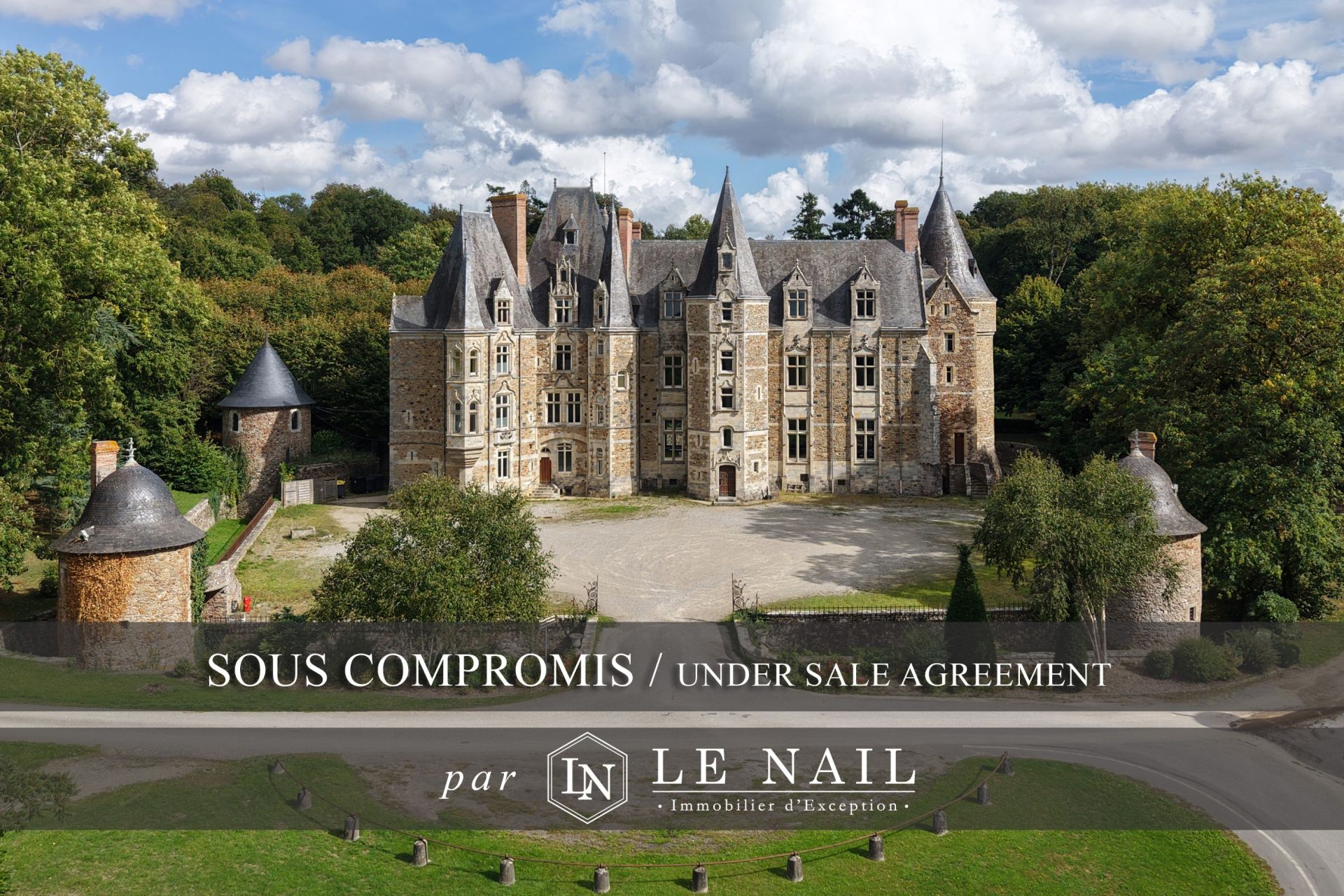
The chateau is built on a quadrangular moated terrace, flanked by three pavilions topped with pepperpot roofs. It includes a main building whose eastern façade is flanked by two towers with pepperpot roofs, while the western façade is flanked by an octagonal tower, which houses the main staircase. To the north, the château is extended by a wing, further enlarged with pavilions and turrets. The play of volumes created by the different parts and types of roofs forms a beautiful effect of asymmetric architecture.
The building is constructed from sandstone rubble, reddish sandstone, and schist. The corner chains, cornices, and ornaments are made of limestone.
The chateau rises on a stone basement level, a ground floor, two upper floors (with two mezzanine levels in the wing), and two levels of attics. It is served by three main staircases and an elevator. Facing east/west, it has a living area of approximately 990 sqm (excluding the two attic levels) and includes:
- Ground floor: 2 rooms (97 and 54 sqm, ceiling height of 5 m), 2 rooms in the round towers (24 and 20 sqm), professional kitchens (producing 150 meals per day), including a dishwashing area, cold storage, pantry, and kitchen (approximately 70 sqm), 2 sanitary blocks on either side of the château with WC and washbasins;
- 1st half-floor (wing): 3 bedrooms, 2 bathrooms, and WC (approximately 40 sqm);
- 1st floor: 5 seminar rooms, a laundry room, and a sanitary block;
- 2nd half-floor (wing): 3 bedrooms, 1 shower room, and a sanitary block with showers and WC (approximately 40 sqm);
- 2nd floor: 8 rooms (seminars), 3 independent WCs, a sanitary block with showers and WCs;
- 3rd and 4th floors: Attics, formerly used as service rooms.
- There is a cellar beneath the main part of the château in the basement, including the boiler room.
Through its current layout, the château has a strong professional use. It has retained beautiful decorative elements, mainly in the neo-Gothic style: a large spiral staircase, wood paneling with napkin fold decorations, monumental fireplaces, mullioned windows with transoms, gables, arches, oriel windows, etc.
OUTBUILDINGS :
They include:
A/ Two pavilions topped with "cock's comb" roofs, located in front of and framing the main courtyard, on either side.
B/ A chapel, in a pavilion to the north of the château; new "cock's comb" roof.
C/ A dovecote in another, larger circular tower, to the southwest of the chateau.
D/ A shed covered with corrugated metal and slate (9 x 15 m), located to the south of the château, downhill from the avenue.
E/ A stone storage building (8 x 9 m), located to the northwest of the chateau.
F/ A well in the château courtyard, not in use.
PROPERTY COMPLEX FOR PROFESSIONAL USE :
To the north of the château, there is a large real estate complex with its parking areas, courtyards, and turning spaces, which includes :
1/ An L-shaped building used for administrative offices, reception, seminars, restrooms, workshops, and storage spaces, heated by electric radiators, with air conditioning. Total floor area: approximately 1,700 sqm.
2/ A shed extending from the L-shaped building, dedicated to the maintenance equipment for the green spaces. Total floor area: approximately 350 sqm.
3/ A U-shaped building with a tower, used as a workers' accommodation (7 rooms), heated by oil. Total floor area: approximately 690 sqm.
4/ A detached house, built on a basement, constructed in the 1970s, consisting of 8 rooms (6 on the ground floor, 2 on the upper floor), heated by oil. Total floor area: approximately 340 sqm.
5/ A stone residential house, covered with slate, comprising 3 bedrooms, extended by a garage. Total floor area (excluding the garage): approximately 150 sqm.
Note: The "total floor area" refers to the total built area of a building, including the floor surfaces of each level, vertical circulation spaces (stairs, elevators, etc.), and measured from the exterior walls.
ERP Standards:
The buildings comply with Public Access Establishments (ERP) standards of the 4th category (for less than 300 people) :
U-type standards: accommodation.
L and N-type standards: seminars and public catering (château).
Regular inspections by the safety commission.
The fire safety system (SSI) is regularly maintained and updated by the company AVICA.
LAND :
The land is crossed by a long avenue that winds downhill from the château and runs through the property from west to east. Two entrance gates are located at each end.
The park is well-maintained and features two distinct areas: an English-style park on the west side with large ornamental trees (Cedars, Sequoias, etc.), French-style gardens on the east side, and a lime tree-lined avenue to the north.
Wooded areas surround the property, creating a natural belt. Some rugged heathland downhill from the avenue and a small water feature complete the landscape, covering a total area of 32,97 acres (13.35 hectares).
Cabinet Le Nail: +33.(0)2.43.98.20.20
CPI 5301 2018 000 028 835 - CCI de la Mayenne
We invite you to visit our website Cabinet Le Nail to browse our latest listings or learn more about this property.
Information on the risks to which this property is exposed is available at: www.georisques.gouv.fr
In Mayenne, about ten kilometres from Laval, this chateau is located in the countryside, in a commanding position and close to a village.
Located at the gateway to Brittany, in the Pays-de-la-Loire region and in the historic province of Maine, Laval has been awarded the ‘Ville d'art et d'histoire’ (City of Art and History) label, and stands out for its rich medieval architectural heritage, dominated by its majestic castle and 13th-century hourd overlooking the river Mayenne.
The town centre is vibrant, with a wide range of facilities (university, hospital, gourmet market) and a strong economic base, particularly in the virtual reality, distribution and dairy sectors.
The town also benefits from excellent transport links, with its TGV station linking Paris in 1 hour 10 minutes, and its proximity to the A81 motorway linking Paris. Surrounded by greenery, Laval is ideal for a country lifestyle, with walks along the river, close to locks and guinguettes, and the pleasures of the surrounding countryside. It's the perfect place to live for families and for working people looking for authenticity and comfort.
The birthplace of Alfred Jarry, the famous author of Ubu Roi, and Ambroise Paré, the ‘Father of modern surgery’, Laval is also inseparable from Douanier Rousseau, the master of naive painting whose works are recognised the world over. These emblematic figures embody the duality of the artistic and innovative soul of Laval, a city that elegantly combines heritage, culture and quality of life.
The chateau is built on a quadrangular moated terrace, flanked by three pavilions topped with pepperpot roofs. It includes a main building whose eastern façade is flanked by two towers with pepperpot roofs, while the western façade is flanked by an octagonal tower, which houses the main staircase. To the north, the château is extended by a wing, further enlarged with pavilions and turrets. The play of volumes created by the different parts and types of roofs forms a beautiful effect of asymmetric architecture.
The building is constructed from sandstone rubble, reddish sandstone, and schist. The corner chains, cornices, and ornaments are made of limestone.
The chateau rises on a stone basement level, a ground floor, two upper floors (with two mezzanine levels in the wing), and two levels of attics. It is served by three main staircases and an elevator. Facing east/west, it has a living area of approximately 990 sqm (excluding the two attic levels) and includes:
- Ground floor: 2 rooms (97 and 54 sqm, ceiling height of 5 m), 2 rooms in the round towers (24 and 20 sqm), professional kitchens (producing 150 meals per day), including a dishwashing area, cold storage, pantry, and kitchen (approximately 70 sqm), 2 sanitary blocks on either side of the château with WC and washbasins;
- 1st half-floor (wing): 3 bedrooms, 2 bathrooms, and WC (approximately 40 sqm);
- 1st floor: 5 seminar rooms, a laundry room, and a sanitary block;
- 2nd half-floor (wing): 3 bedrooms, 1 shower room, and a sanitary block with showers and WC (approximately 40 sqm);
- 2nd floor: 8 rooms (seminars), 3 independent WCs, a sanitary block with showers and WCs;
- 3rd and 4th floors: Attics, formerly used as service rooms.
- There is a cellar beneath the main part of the château in the basement, including the boiler room.
Through its current layout, the château has a strong professional use. It has retained beautiful decorative elements, mainly in the neo-Gothic style: a large spiral staircase, wood paneling with napkin fold decorations, monumental fireplaces, mullioned windows with transoms, gables, arches, oriel windows, etc.
OUTBUILDINGS :
They include:
A/ Two pavilions topped with "cock's comb" roofs, located in front of and framing the main courtyard, on either side.
B/ A chapel, in a pavilion to the north of the château; new "cock's comb" roof.
C/ A dovecote in another, larger circular tower, to the southwest of the chateau.
D/ A shed covered with corrugated metal and slate (9 x 15 m), located to the south of the château, downhill from the avenue.
E/ A stone storage building (8 x 9 m), located to the northwest of the chateau.
F/ A well in the château courtyard, not in use.
PROPERTY COMPLEX FOR PROFESSIONAL USE :
To the north of the château, there is a large real estate complex with its parking areas, courtyards, and turning spaces, which includes :
1/ An L-shaped building used for administrative offices, reception, seminars, restrooms, workshops, and storage spaces, heated by electric radiators, with air conditioning. Total floor area: approximately 1,700 sqm.
2/ A shed extending from the L-shaped building, dedicated to the maintenance equipment for the green spaces. Total floor area: approximately 350 sqm.
3/ A U-shaped building with a tower, used as a workers' accommodation (7 rooms), heated by oil. Total floor area: approximately 690 sqm.
4/ A detached house, built on a basement, constructed in the 1970s, consisting of 8 rooms (6 on the ground floor, 2 on the upper floor), heated by oil. Total floor area: approximately 340 sqm.
5/ A stone residential house, covered with slate, comprising 3 bedrooms, extended by a garage. Total floor area (excluding the garage): approximately 150 sqm.
Note: The "total floor area" refers to the total built area of a building, including the floor surfaces of each level, vertical circulation spaces (stairs, elevators, etc.), and measured from the exterior walls.
ERP Standards:
The buildings comply with Public Access Establishments (ERP) standards of the 4th category (for less than 300 people) :
U-type standards: accommodation.
L and N-type standards: seminars and public catering (château).
Regular inspections by the safety commission.
The fire safety system (SSI) is regularly maintained and updated by the company AVICA.
LAND :
The land is crossed by a long avenue that winds downhill from the château and runs through the property from west to east. Two entrance gates are located at each end.
The park is well-maintained and features two distinct areas: an English-style park on the west side with large ornamental trees (Cedars, Sequoias, etc.), French-style gardens on the east side, and a lime tree-lined avenue to the north.
Wooded areas surround the property, creating a natural belt. Some rugged heathland downhill from the avenue and a small water feature complete the landscape, covering a total area of 32,97 acres (13.35 hectares).
Cabinet Le Nail: +33.(0)2.43.98.20.20
CPI 5301 2018 000 028 835 - CCI de la Mayenne
We invite you to visit our website Cabinet Le Nail to browse our latest listings or learn more about this property.
Information on the risks to which this property is exposed is available at: www.georisques.gouv.fr
Your contact

Siège
- +33 (0)2 43 98 20 20